The GTI Research Institutions Network is a long-term effective academic cooperation mechanism to prioritize development projects and research activities and thus to facilitate economic cooperation with a view to bringing common prosperity and development opportunities in the region. This will serve as GTI’s brain trust which is composed of four leading National Research Institutions of GTI member countries, namely, China Association of International Trade (CAIT); Russian Foreign Trade Academy (RFTA); Institute for Strategic Studies, National Security Council of Mongolia (ISS); and Korea Institute for International Economic Policy (KIEP).
Following several preliminary discussions, member countries of GTI endorsed the establishment of the GTI Research Institutions Network to promote economic cooperation and integration in Northeast Asia and also adopted the Concept Note as the basis for future discussion among the above-mentioned representative research institutions designated by each member country at the 15th CC Meeting in September 2014 in Yanji, China.
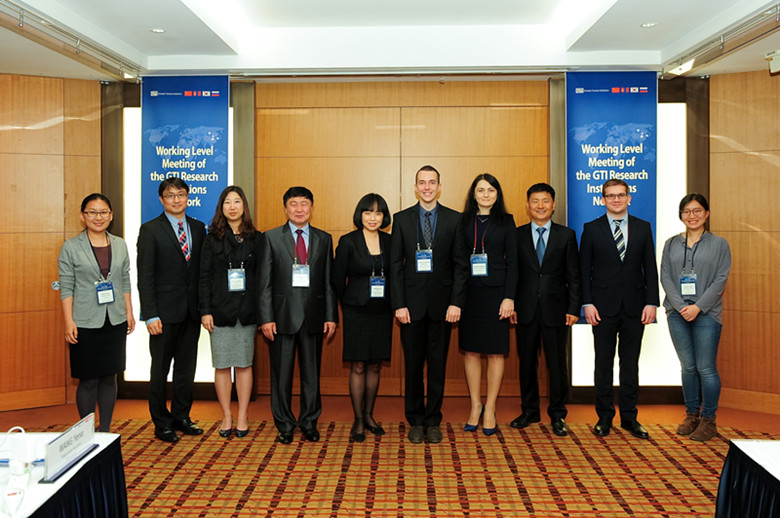
The 1st Working-level Meeting (Post-Inauguration) of RIN was successfully held on 21-22 September 2016 in Moscow, Russia. The meeting was co-organized by RFTA and the GTI Secretariat. Member institutions introduced and shared their ongoing and planned research work and activities related to the GTI issues for 2016. The participants subsequently discussed on three proposals of joint research projects including “Promoting the Connectivity in GTI” from RFTA, “Building a Cross-border Free Trade Zone in NEA” from KIEP and “The Prospect of North-east Asia Economic Cooperation (NEAEC)” from CAIT. After in-depth review by member institutions, member institutions made an agreement the selection of the two proposals as the 1st Joint Research Projects of RIN. The one is CAIT’s proposal and the other is the proposal on connectivity issues of GTI which will combine RFTA’s and KIEP’s proposal into one.
Since the 1st Working-Level Meeting, RFTA and CAIT as respective leading research institutions for the above-mentioned two projects submitted the project proposals to the GTI NCs for their review and the official request of funding from GTI including ROK Trust Fund or GTI Special Account of Common Fund. The title of the projects was refined to “Promoting the Connectivity in GTI in Physical, Institutional and People-to-People Dimensions” (RFTA) and “The History and Prospect of Greater Tumen Regional Cooperation” (CAIT) respectively.
At the 1st NC meeting 2017 on 15-16 March in Beijing, China, NCs reviewed the proposals after the Secretariat’s brief on their rationale, objectives and research plans. The first proposal on Connectivity topic was decided to be carried out as the first joint research project of GTI RIN under the financial support from ROK Trust Fund and will be submitted to the next CC meeting for its final approval. As for the second proposal, NCs requested RIN to keep more investigation and discussion on its budget and scope.
Since then, a few developments, including change of leading institution from RFTA to KIEP and increase in the project budget, were made on the first proposal through the discussions of RIN members. The second proposal was also further updated with reducing the portion of Special Account’s support from 80% to 20% of the total estimated budget. The revised proposals, namely “Promoting the Connectivity in GTI in Physical, Institutional and People-to-People Dimensions” (KIEP) and “Prospect of Greater Tumen Regional Cooperation” (CAIT), were resubmitted to the 2nd NC meeting 2017 on 15 June in Beijing and finally approved by NCs.
The 3rd Working-level meeting of RIN was successfully held on 19-21 October 2017 in Dalian, China. At the meeting, the participants reviewed the overall work plan of RIN joint research projects and confirmed the revised joint project timeline. The date of the 4th Working-level meeting was discussed, and all participants have reached an agreement that the date of the next Working-level meeting would be decided later considering the exact date of 18th CC Meeting and the need to secure enough time for reviewing the preliminary result of the joint projects. Besides, the participants agreed to the Terms of References of two joint research projects and also adopted the budget allocation plan prepared by KIEP.
The 4th Working-level meeting of RIN was held on 21 June 2018 in Ulaanbaatar, Mongolia back to back with the 18th GTI Consultative Commission. At the meeting, CAIT made a brief introduction to the first version of its joint study, “Prospect of Greater Tumen Regional Cooperation.” KIEP, in its joint study, proposed an idea of ‘small city-level free trade agreement among GTI countries’ as an effective way to promote connectivity between member countries under which some policy measures, such as favorable duty, duty-free zone, particular merchandise trade and easier visa pass for travelers, could be taken. Other member institutions took a cautious attitude toward the KIEP’s proposal by the reason that there may be conflicts between the proposal and the member government’s domestic initiative for developing the GTR. Instead, ISS suggested a regional cluster as an alternative idea to KIEP’s proposal, which aims to export to another region of the world instead of just focusing on inter-regional trade of GTI member countries, while RFTA mentioned about Korean ‘export promoting agency’ as a good example that member countries can benchmark.
The 5th (post-inauguration) Working-Level Meeting of the GTI RIN was held on 30 August 2018 in Hunchun, China. At the meeting, the member institutions discussed the progress of the joint project of “Promoting Connectivity in GTI in Physical, Institutional, and People-to-People Dimensions” with KIEP as a project leader. KIEP pointed out several parts of the draft report of the project which needs to be reconsidered and complemented by each member institutions according to their respectively allocated parts for a more improved and complete final result. As the first round of the joint project is coming to a close, RIN needs to prepare a new joint project. KIEP proposed a potential candidate for the new project, which is called “Study on regional value chain (RVC) in GTR and promotion of economic integration.” In its presentation, KIEP explained the rationale, logic, and main contents of the new topic adding that the best way to create regional value chain is to complement each other among GTI member countries rather than to compete against others. Following the presentation, some of the member institutions expressed their interests toward the new project and promised to support its implementation.
The proposed objectives of the Network based on the principle of equality, mutual benefits, and mutual respect could include the following:
- The establishment of an inter-research institution network closely associated with GTI Secretariat and member countries to serve as GTI’s Brain Trust in providing policy suggestions and consulting advice to GTI in order to enhance cooperation in NEA.
- To conduct in-depth research on NEA and the Greater Tumen Region economies, providing concrete recommendations on long-term direction and strategies to the GTI and development projects relevant to GTI, thus strengthening the institutional capacity of GTI
- To deepen cooperation and dialogue among policy research institutions, and facilitate research activities on economic cooperation and integration in NEA

/VEB logo.png)